Introduction
Complex software has a way of outgrowing its own interface. A dashboard that made sense with three users and one data source turns into a maze once you add role-based permissions, AI features, and a compliance team asking for a VPAT.
Many US product teams struggle with exactly this: interfaces that are hard to validate, expensive to maintain, and painful to scale.
Strong product design agencies handle more than visual polish. They combine user research, product strategy, interaction design, accessibility practices, and real development collaboration into one connected process, as Nielsen Norman Group notes in its work on complex application design.
This guide shortlists five agencies for US product teams in 2026. Each was evaluated on specialization, evidence of relevant work, process maturity, technical collaboration, accessibility practices, and fit for different buyer needs.
Key Takeaways
- Product design agencies turn user research into simpler workflows and buildable software strategy.
- Match the agency to product complexity, industry, growth stage, and accessibility or development needs.
- Yes Yes Know suits complex B2B software, SaaS, cybersecurity, fintech, and data-heavy products needing research-led, accessible UX.
- Always verify current pricing, team involvement, and case-study outcomes before treating any ranking as final.
Overview of Product Design Agencies in the US Market
A product design agency connects user research, business objectives, interaction design, visual systems, prototyping, validation, accessibility, and technical implementation into a single engagement. That's a broader remit than hiring someone to make an interface look polished.

US software companies increasingly need this specialized support because of a few recurring patterns:
- Enterprise dashboards with role-based workflows serving multiple user types at once
- AI-enabled products that need explainable interfaces and human-in-the-loop controls
- Regulated industries, such as fintech and healthcare, where errors carry real consequences
- Design debt from years of shipping features fast without revisiting the underlying architecture
According to UX Design Institute, product design is a cross-functional discipline spanning research, strategy, UX/UI, and business goals. UX design is one component of that broader remit, while UI design focuses narrowly on an interface's look and interactivity.
Branding and web design are different disciplines entirely. A portfolio full of marketing sites doesn't prove software-product experience.
That distinction matters when you're comparing agencies below. Some specialize in product work end to end. Others are stronger in adjacent disciplines and worth knowing about for that reason.
Top Product Design Agencies in 2026
This is a practical, US-focused shortlist, not a claim that one agency wins every brief. Each profile below draws on current public sources, and we've flagged where pricing or outcome data wasn't publicly available.
Yes Yes Know
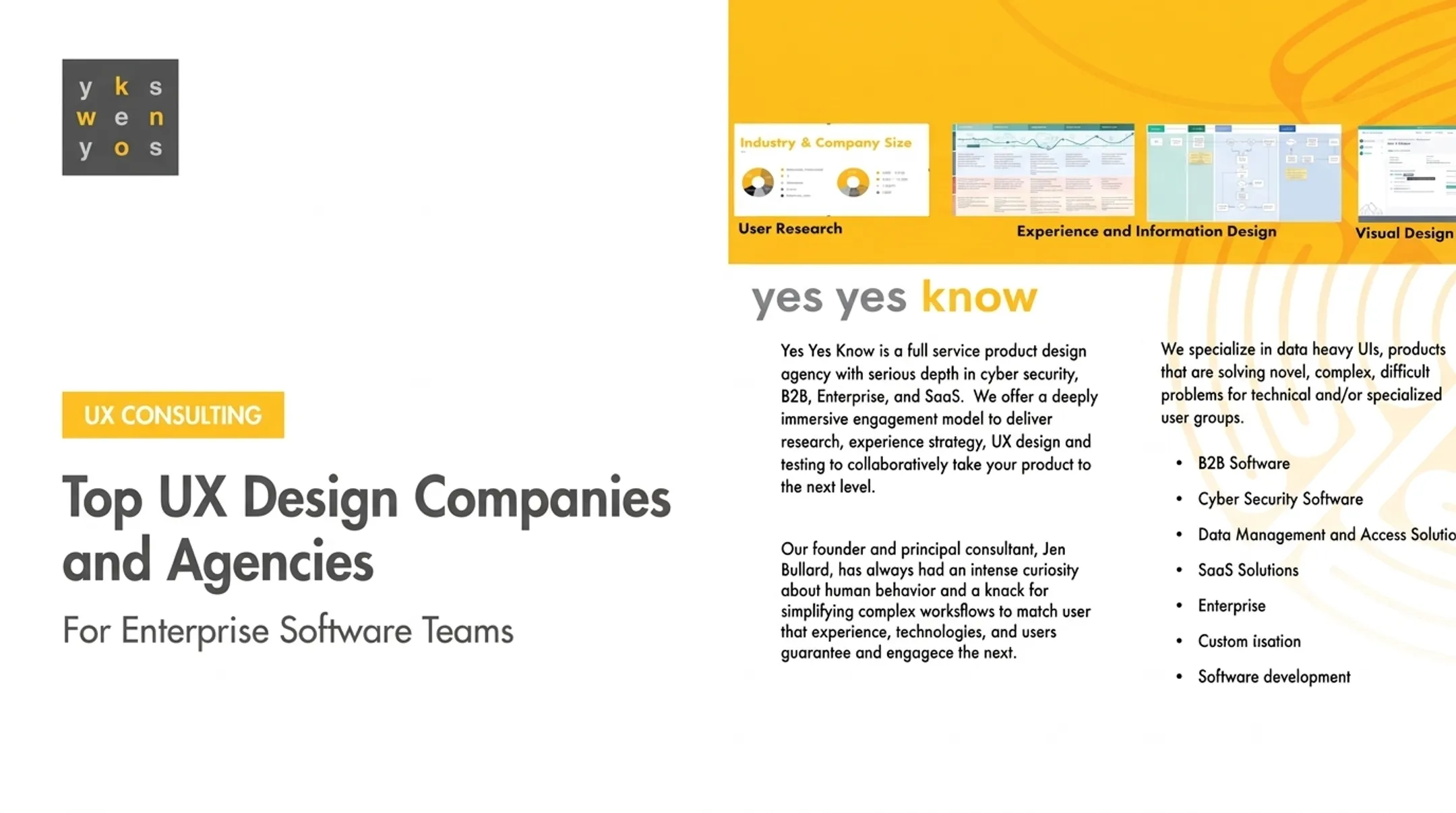
Yes Yes Know is a Cambridge, Massachusetts-based product design and UX agency founded in 2019 by Jen Bullard, an HCI-trained practitioner with more than 20 years of experience in web and software development.
The firm works with B2B software, enterprise SaaS, cybersecurity, fintech, and data management organizations, the kinds of products where a confusing workflow doesn't just annoy users, it costs deals.
What sets the approach apart is scope. Engagements move through three iterative phases, understanding, designing, and building, with accessibility considered at every stage rather than tacked on at the end. Services include:
- UX audits and strategy: evaluating goals, team composition, and existing UX processes before recommending a path forward
- User research: interviews, journey mapping, card sorting, and tree testing
- Design: information architecture, wireframes, prototypes, and UI design
- Usability testing and validation: session recording, time-on-task measurement, and friction-point analysis
- Accessibility: WCAG 2.2 AA evaluation, VPAT support, and PDF remediation
- Development collaboration: building maintainable solutions that fit a client's existing architecture
Founder Jen Bullard holds a CPACC certification through the International Association of Accessibility Professionals, a verified credential that backs up the firm's accessibility claims rather than just asserting them.
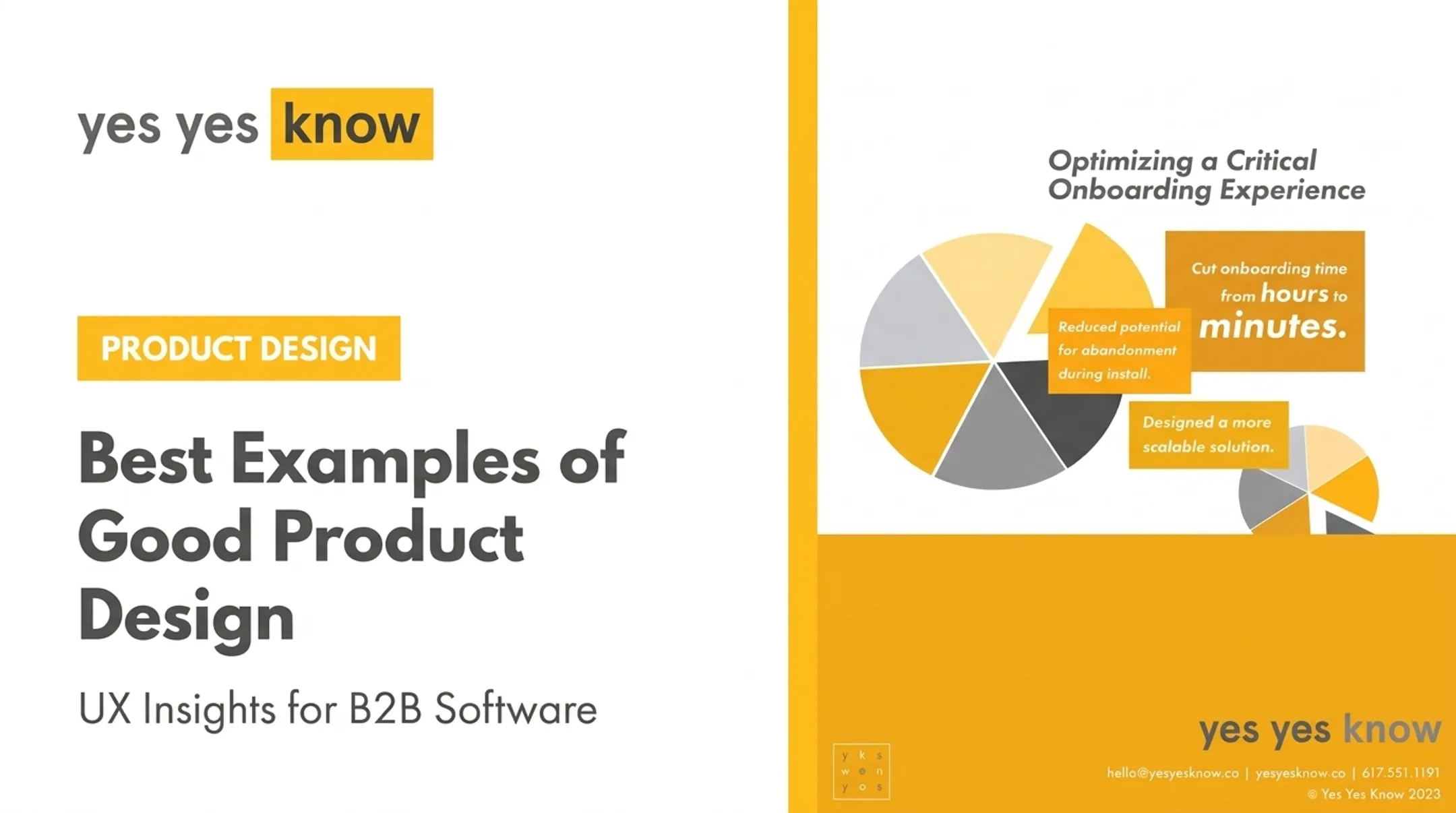
The firm's client work spans Harvard Kennedy School's intranet redesign, Starburst Data (where usability testing cut solution setup time from three hours to three minutes), and ThreatX's API security catalog covering more than 900 endpoints.

Fact box:
| Attribute | Details |
|---|---|
| Best for | Complex B2B, SaaS, cybersecurity, fintech, and data-heavy products |
| Key services | Audits, research, design, usability testing, accessibility, development |
| Industries | B2B software, enterprise SaaS, cybersecurity, fintech, data management |
| Headquarters | Cambridge, MA (remote and in-person) |
| Accessibility | WCAG 2.2 AA audits, VPAT support, PDF remediation, CPACC-certified founder |
| Pricing | Flat-fee UX audit from $5,000; flat-fee or time-and-materials for larger scopes |
Watch out: Yes Yes Know's model is built around deep, senior-led engagement rather than a large implementation bench. Buyers needing extensive global delivery capacity or multinational program governance across dozens of markets may want to compare it against larger firms with bigger staffing pools.
If your product has a complex B2B software, SaaS, cybersecurity, fintech, or accessibility challenge, it's worth reviewing Yes Yes Know's UX and product design services or requesting an initial conversation.
ParallelHQ
ParallelHQ positions itself around AI product design, end-to-end product flows, and engineering-ready design systems, alongside user research and usability testing. Its published AI-software offering covers onboarding, explainable interfaces, human-in-the-loop controls, and predictive dashboards, which is a specific and increasingly relevant niche.
The firm's UX-audit process runs through stakeholder discovery, heuristic evaluation, usability testing, and prioritized fixes with developer handoff guidance, an appealing structure for teams that want a fast, scoped starting point. It describes working in weekly sprints as an extension of the client's team, welcoming inquiries from early-, mid-, and late-stage companies alike, not just startups.
Fact box:
| Attribute | Details |
|---|---|
| Best for | AI-enabled and SaaS products needing rapid, sprint-based design |
| Core services | UX audits, product design sprints, prototyping, usability testing |
| Client stage | Early to late stage; enterprise inquiries accepted |
| Location | Austin, TX, and Bengaluru, India; remote delivery |
| Pricing | Engagements typically start around $10,000 |
| Limitation | No formal WCAG accessibility credential documented in public service pages |
MetaLab
MetaLab has a well-known name in product design circles, with portfolio credits including Slack's original product suite and feature-concepting work alongside Loom's in-house team. That kind of consumer-grade craft appeals to well-funded startups and scale-ups chasing a highly polished product experience.
Its team operates across multiple hubs, including Victoria, Vancouver, Toronto, New York, and London, giving it real geographic reach for distributed client teams.
Fact box:
| Attribute | Details |
|---|---|
| Best for | Well-funded startups and scale-ups wanting senior-level craft |
| Core capabilities | Product strategy, UX research, product design, engineering |
| Evidence | Slack product suite, Loom feature concepting |
| Locations | Victoria, Vancouver, Toronto, New York, Los Angeles, London, Austin |
| Pricing | Directory listings show a $50,000+ minimum budget |
| Limitation | May be too large or expensive for smaller-scope engagements |
Cieden
Cieden takes a strongly B2B-oriented approach, combining product design, UX/UI, business analysis, and web-app development under one roof. Its portfolio includes B2B SaaS work tagged across fintech, healthcare, and real estate, including a role-based pricing dashboard for a fintech client and an account-based-marketing MVP.
The firm describes itself as remote-first, with teams across Europe and North America, and it publishes pricing more transparently than most competitors on this list.
Fact box:
| Attribute | Details |
|---|---|
| Best for | B2B SaaS, fintech, healthcare, and real estate needing design plus implementation |
| Service scope | Research, UX/UI design, business analysis, web-app development |
| Industries | SaaS, fintech, digital health, real estate |
| Pricing | Project work from $50/hour; UX audit from $2,000; design sprint from $7,000 |
| Watch out | Remote, distributed delivery model; confirm team continuity across project phases |
Work & Co
Work & Co connects design directly to engineering, which suits teams that want one partner handling both the interface and the build. Its client roster includes digital banking work for Chase and product improvements for Mailchimp's core platform, alongside full-stack development and accessibility implementation and testing.
The firm joined Accenture Song in 2024, giving it access to larger enterprise programs, with hubs spanning Brooklyn, Portland, Atlanta, Copenhagen, and Belgrade.
Fact box:
| Attribute | Details |
|---|---|
| Best for | Enterprise teams needing combined design-and-development delivery |
| Services | Research, prototyping, UX/UI, full-stack development, accessibility testing |
| Sectors | Financial services (Chase), SaaS (Mailchimp) |
| Locations | Brooklyn, Portland, Los Angeles, Atlanta, São Paulo, Copenhagen, Belgrade |
| Limitation | A design-only audit or small discovery sprint may need a different type of specialist; public review data is limited |
How We Chose the Best Product Design Agencies
Selecting agencies for this list meant checking official service pages, current case studies, independent directory profiles, and any publicly disclosed pricing or credentials, rather than relying on marketing copy alone.
We looked for product and domain fit: experience with complex workflows, data-heavy interfaces, SaaS, fintech, cybersecurity, or regulated environments. Then we assessed process quality against Design Council's Double Diamond model: discovery, definition, development, and delivery, with real user testing at each stage.
Commercial and operational fit mattered too:
- Pricing transparency: does the agency publish rates or minimums, or hide them entirely?
- Agency size and senior involvement: will a senior designer actually work on your project?
- Availability and communication model: sprints, retainers, or project-based engagement?
- Implementation capacity: can the agency support your current product stage and engagement model?
We also weighed accessibility evidence against the W3C's WCAG evaluation methodology, which notes that automated tools alone can't catch every issue and competent evaluation requires human judgment.

A caution: don't choose based solely on visual portfolio quality, client-logo volume, or awards. Ask for comparable case studies, named team members, and outcome evidence. Rankings shift as agencies update services, pricing, and teams, so treat this list as a snapshot, not a permanent verdict.
Conclusion
The right product design agency should match your product’s complexity, users, industry, and accessibility obligations—not brand recognition alone.
Before you sign, compare discovery quality, research rigor, validation methods, senior involvement, and total cost across your shortlist.
Ask pointed questions:
- Who on the team will actually do the work?
- What does their usability testing process look like in practice?
- Can they show accessibility evidence, not just claim it?
If you need research-led, accessible UX for complex B2B software, SaaS, cybersecurity, fintech, or enterprise products, Yes Yes Know is worth a conversation.
Frequently Asked Questions
How much does it cost to hire a product designer?
Costs vary widely by seniority, agency model, and scope. Clutch's product design pricing guide places typical reviewed projects between $10,000 and $49,999, with US-based agency rates often running $100-$149 per hour.
How do I get an agency for a product?
Start by defining your project goals, budget, and core user problems. Build a shortlist, review case studies, compare proposals, and check references, often starting with a small audit before committing to a full build.
Are product designers still in demand?
Yes. As software grows more complex, demand is shifting toward designers with research skills, systems thinking, accessibility knowledge, and engineering collaboration, not just visual polish.
Is AI replacing product designers?
No. AI speeds up research synthesis and prototyping, but Figma's 2025 AI report found only 32% of users fully trust AI output without review. Human judgment, empathy, and accessibility expertise remain essential.
What does a digital product designer do?
They investigate user needs, map workflows, design interactions and interfaces, build prototypes, test them with real users, and collaborate closely with product and engineering teams.
What is a design consulting firm?
A design consulting firm advises on product, UX, or design strategy and may also conduct research, create designs, validate solutions, and support implementation, functioning as an extension of the client's internal team.