Many product teams struggle with unclear role boundaries, leading to duplicated work, misallocated budgets, and hiring decisions that don't match actual needs. When leadership can't distinguish where usability work ends and business strategy begins, projects stall and roadmaps drift.
The financial case for getting this right is substantial. A Forrester study commissioned by IBM modeled a 301% three-year ROI for a composite organization applying structured design thinking practices, with $48.4 million in projected benefits (Forrester Consulting/IBM, 2018). This article breaks down exactly where UX design and product design overlap, where they diverge, and how B2B software leaders can deploy both effectively.
Key Takeaways
- UX design centers on journeys, usability, and accessibility so users complete tasks with less friction
- Across the full lifecycle, product design balances those user needs against business viability
- They diverge in scope and deliverables: UX optimizes task success; product design optimizes product outcomes
- B2B software teams that run both functions together cut churn and speed adoption
User Experience vs. Product Design: Quick Comparison
Here's how these disciplines compare across the dimensions that matter most to technical leaders.
| Dimension | User Experience (UX) | Product Design |
|---|---|---|
| Primary Focus | Solving usability problems and reducing cognitive friction in interaction flows | Balancing user satisfaction with revenue goals and long-term roadmap viability |
| Core Deliverables | Journey maps, wireframes, usability testing reports, information architecture | Product strategy, design systems, functional prototypes, feature prioritization models |
| Scope of Involvement | Execution and optimization phases of interaction design | Entire lifecycle, from concept discovery through post-launch iteration |
| Success Metrics | Task completion rates, error rates, SUS scores, accessibility compliance | Customer lifetime value, conversion rates, churn reduction, feature adoption |
| Strategic Alignment | Champions user ergonomics within complex workflows | Bridges engineering, user empathy, and commercial objectives |
UX metrics measure interaction quality. Product design metrics measure business outcomes. Neither tells the full story on its own, so enterprise teams need both working in tandem.
What is User Experience (UX) Design?
UX design shapes how a user moves through a digital product—and whether that path feels effortless or exhausting. On complex B2B and SaaS platforms, where people repeat the same multistep workflows dozens of times a day, strong UX decides whether the software is an asset or a liability.
UX work typically breaks down into several sub-disciplines:
- User research — interviews, surveys, and behavioral analysis to understand real user needs
- Information architecture — organizing content and features so users can find what they need
- Interaction design — defining how users engage with specific elements and workflows
- Accessibility compliance — meeting WCAG and ADA standards for users with disabilities
- Usability testing — validating designs against real user behavior before and after launch
Why Fixing UX Early Saves Money
The cost of ignoring usability compounds over time. NIST's software testing research found that defects caught during requirements and design cost roughly 1x to fix, versus as much as 30x once a product reaches production (NIST, 2002).

Late rework follows the same pattern most engineering teams already know: the further a usability issue travels into the build, the more expensive it becomes.
Use Cases of UX Design
UX design pays off fastest in high-friction product moments, such as:
- Untangling a dense data table that buries the metric a user needs
- Cutting a seven-step approval workflow down to three
- Rebuilding navigation so new users finish setup instead of abandoning it
Stakes climb further in regulated or time-sensitive industries:
- Fintech — dense, regulated workflows that still need to feel fast and trustworthy for professional users
- Healthcare IT — an AHRQ review found that more than one-third of 9,000 medication-related safety reports across three academic health institutions involved EHR usability issues, with nearly 20% potentially linked to patient harm (AHRQ, 2018)
- Cybersecurity — interfaces where a confusing dashboard can delay threat detection
Those same workflow problems show up in real B2B products. At Yes Yes Know, usability testing and targeted UX remediation for Starburst Data cut setup time on their cloud-based solution from three hours to three minutes. That gap is the difference between a user finishing onboarding and abandoning it.
What is Product Design?
Product design grew out of industrial design, where teams shaped physical objects around ergonomics and manufacturing constraints. As software became the product, that discipline widened into a method for building digital products that satisfy users and hold up in a competitive market.
Where UX asks "can the user complete this task," product design asks a bigger question: "should we build this feature, and will it move the business forward?" Product designers own:
- Business analysis and market positioning
- Visual interface and interaction decisions
- Stakeholder alignment across engineering, sales, and leadership
- Post-launch iteration guided by adoption data
Why Scope Matters for Growth Companies
Product designers also track business signals that UX specialists typically don't. Customer acquisition cost, competitive feature gaps, and pricing pressure all shape what gets built next. That wider lens is how product design creates durable differentiation instead of only refining the current UI.
Where Product Design Has the Most Impact
The same discipline applies from zero-to-one discovery (should this product exist?) through enterprise scale (can we support ten times the users?).
Common high-impact scenarios:
- Enterprise software redesigns that modernize legacy systems without breaking customer workflows
- Multi-platform SaaS suites that stay consistent across web, mobile, and API-driven products
- New market entry that tests whether a feature set fits an underserved segment
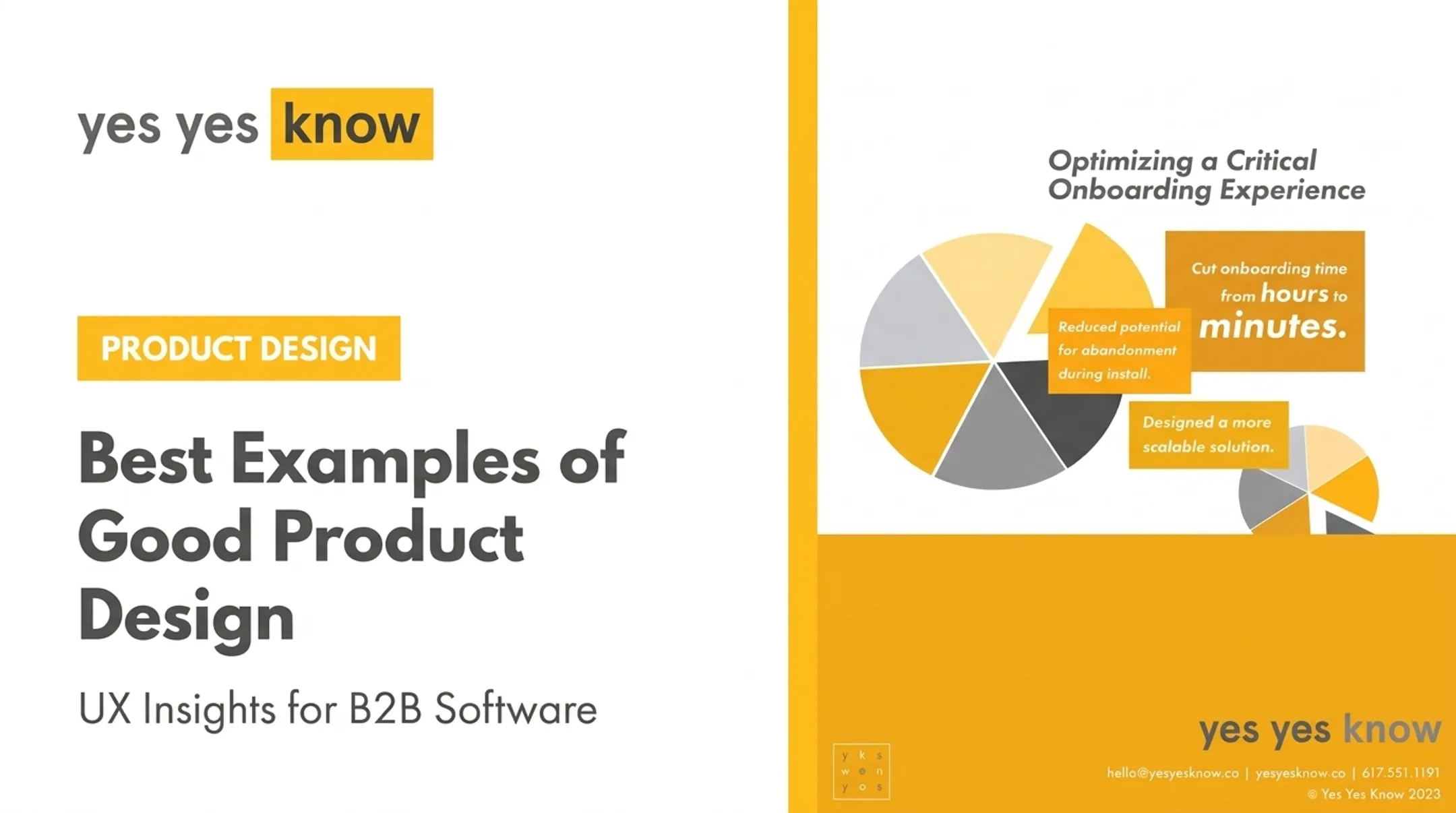
In one B2B software engagement, Yes Yes Know rebuilt a critical onboarding flow through research, interface redesign, and tighter feature prioritization. The result was faster time-to-value and less risk of install abandonment—product decisions tied directly to retained revenue.

UX vs. Product Design: What is Better?
This is the wrong question, honestly. The better question is: which capability does your organization need right now?
Choose specialized UX design when:
- Users struggle with complex workflows and usability metrics are poor
- You're facing accessibility remediation deadlines
- Support tickets are climbing due to confusing interfaces
Choose product design when:
- You're launching a new commercial product from scratch
- You're re-architecting an entire product suite for market growth
- Business viability questions are unanswered
Many organizations don't have to choose one or the other. Yes Yes Know's engagement model treats development, UX, and product management as three legs of the same stool, drawing on Marty Cagan's framing that great products meet user needs and business objectives at the same time.
Partners who pair deep UX research and accessibility audits with product strategy help B2B software leaders skip that false choice—and keep teams from working in isolation.
To avoid organizational silos, cross-functional teams should:
- Share research findings between UX and product functions, not just outcomes
- Include UX specialists in roadmap planning, not just execution
- Set shared success metrics that combine usability and business KPIs
Real-World Examples and Practical Applications
Picture a mid-market B2B software company with a data-heavy analytics platform. Churn is climbing. Support tickets keep piling up. The product team suspects design debt but can't pinpoint the cause.
The diagnostic step: A comprehensive UX audit examining core user flows uncovers the real issue. Users are getting lost in a navigation structure that grew organically over five product releases, with no one revisiting the architecture as features piled on.
The strategic decision: Rather than treating this as a pure UX fix, the team combines workflow remediation with longer-term product design strategy. That work addresses both the immediate friction and the feature prioritization process that created it.
Measurable outcomes that matter to technical leadership:
- Reduced user error rates across critical workflows
- Faster feature adoption after redesign
- Shorter onboarding timelines for new accounts
This mirrors what happened with Starburst Data's onboarding overhaul, where setup time dropped from hours to minutes through combined research and design work.

If your platform shows similar warning signs, a UX audit or product design consultation with Yes Yes Know can help evaluate usability and business alignment before churn accelerates further.
Conclusion
UX design and product design share a budget line as complementary functions, not rivals. UX asks whether users can finish their tasks. Product design asks whether the product makes business sense. Treat them as interchangeable—or hire for one when you need the other—and you get rework and misalignment that slow growth.
Getting this right pays off in concrete terms:
- Reduced development rework
- Faster onboarding
- Lower churn
- Stronger user retention
For technical leaders and product managers, the job is to align user empathy with business strategy on purpose, from the first audit through post-launch iteration.
Frequently Asked Questions
What is UX in product design?
UX serves as the user-centered foundation within product design, ensuring concepts are functionally usable, intuitive, and accessible. Product design then layers business, market, and technical feasibility on top of that foundation.
What is UI/UX?
UI/UX refers to the combined discipline covering user interface (visual elements, typography, layouts) and user experience (overall functionality, navigation, and satisfaction). The two work together but measure different things.
What is the difference between UI and UX?
UI is the visual and interactive surface users see—buttons, colors, typography, and layouts. UX covers the full journey: task flows, problem-solving structure, and how the product feels to use.
What does user experience design do?
UX design finds user pain points through research, maps intuitive task flows, and tests prototypes with real users. It also keeps interfaces easy to navigate and accessible, including for people who use assistive technology.
What is a UX product?
A UX product is any digital application or software platform that has been intentionally architected and validated around user needs and behavioral data, rather than built purely on assumptions about what users want.
What are examples of UI and UX?
UI examples include buttons, color palettes, and input fields—the visible components users tap or click. UX examples include fewer checkout steps, clearer data filters, and search that helps users finish tasks without friction.