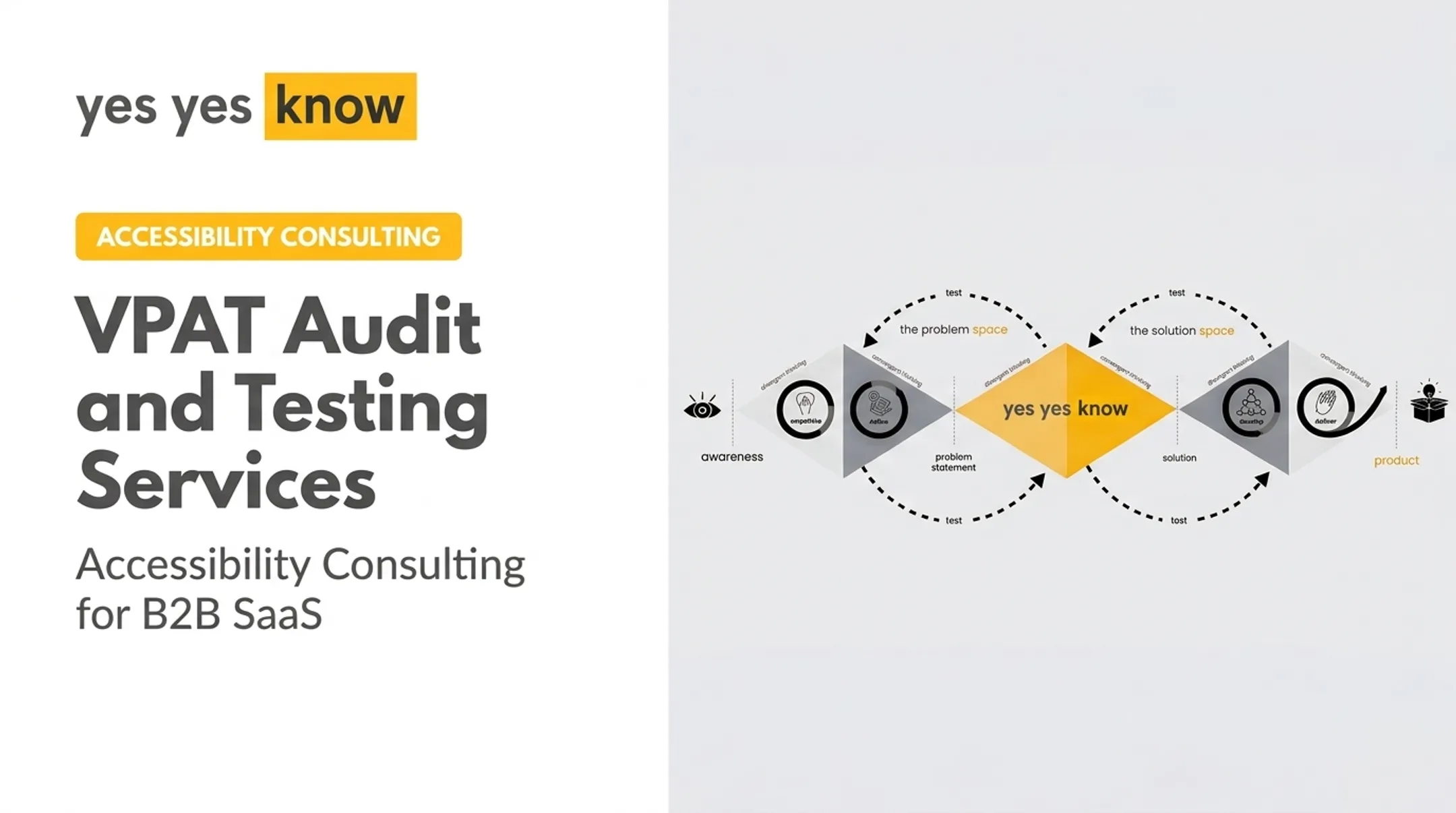
This guide provides a comprehensive overview for B2B software teams looking to build more effective products. We’ll cover what design testing is, explore different methods, walk through a seven-stage process, and share techniques for analyzing results—all with a focus on the unique challenges of complex, data-heavy software and accessibility.
Key Takeaways
- Start testing before development begins and continue iteratively, rather than saving it for a final QA check.
- The method you choose should align with the decision you need to make, whether it's about comprehension, navigation, usability, or accessibility.
- Combine qualitative observations (the why) with quantitative evidence (the what) for a complete picture.
- Always test with representative users in realistic scenarios, especially for products with specialist roles or complex workflows.
- Treat findings as inputs for prioritized design changes, then re-test the revised experience to confirm improvements.
What Is Design Testing and Why Does It Matter?
Design testing is the structured evaluation of concepts, wireframes, prototypes, and interfaces with users to identify problems and validate design decisions. It’s about observing people as they interact with a design to see what works and what doesn't.
It’s crucial to distinguish design testing from software quality assurance (QA). QA primarily verifies if a built system functions according to its technical specifications. Design testing, on the other hand, evaluates whether the experience is understandable, usable, and accessible for the people it's intended to serve.
Design testing answers critical questions that technical checks can't:
- Can users understand the purpose of the interface and what to do next?
- Are they able to complete important tasks accurately and efficiently?
- Does the design align with their mental model and real-world context?
- Can people with different abilities access and operate the experience?
The business value of testing early is enormous. It reduces costly design rework, exposes incorrect assumptions before they're coded, and improves user adoption. For instance, after we conducted usability testing for a data infrastructure client, they refined their onboarding flow and cut setup time from three hours to under three minutes.

Testing provides the concrete evidence needed to make confident, user-centered decisions and gain stakeholder buy-in. Design testing observes how people actually use an interface, revealing whether it meets their real needs rather than asking them to become designers themselves.
What Are the Different Types of Testing Methods?
No single testing method fits every situation. The right choice depends on your research question, the maturity of your design, and the evidence you need. Here are some of the most common approaches for B2B software teams.
Moderated vs. Unmoderated Testing
- Moderated usability testing: A facilitator guides participants through tasks live (in person or remote). Best for complex workflows and follow-ups; costs more in scheduling time and can introduce facilitator influence.
- Unmoderated remote testing: Software presents tasks for participants to complete on their own. Scales to larger, geographically diverse samples, but weak task wording can produce ambiguous results with no one to clarify.
Qualitative vs. Quantitative Testing
- Qualitative (formative) testing: Discovers why users struggle—behaviors, mental models, and confusion points—usually with small samples during iterative prototyping.
- Quantitative (summative) testing: Measures outcomes like completion rates, task time, or satisfaction. Needs larger samples and supports benchmarking against a prior version or competitor.
Lightweight Evaluative Methods
For quick feedback on specific design elements, use these methods:
- Five-Second Testing: Shows a design for five seconds, then asks what users remember—strong for first impressions, message clarity, and visual hierarchy.
- First-Click Testing: Presents a task and records where users would click first, revealing whether navigation matches expectations.
- Preference Testing: Shows two or more variations and asks which users prefer. Useful signal, but preference does not equal usability.
- Card Sorting & Tree Testing: Evaluate information architecture—card sorting builds structure from mental models; tree testing validates existing navigation. We used both to clarify a complex intranet for Harvard Kennedy School.
Expert Methods
These methods complement user testing by leveraging established principles:
- Heuristic Evaluation: An expert reviews your interface against usability principles (heuristics). At Yes Yes Know, our $5,000 flat-fee UX Audit includes a heuristic and task-based review of core user flows.
- Cognitive Walkthroughs: An expert steps through a task as a new user to flag potential learning issues.
- Accessibility Audits: A specialist evaluates your product against standards like the Web Content Accessibility Guidelines (WCAG).
The goal is to select the smallest combination of methods that provides the evidence you need to make the next decision, not to test every aspect of a design at once.
The 7-Stage Design Testing Process
A structured process keeps testing rigorous, repeatable, and tied to decisions you can act on.
Define the Decision and Objectives: State what the team needs to decide, which user problem and assumptions you are testing, and what evidence would be strong enough to change direction.
Identify Users, Scenarios, and Scope: Describe target users by role, experience level, and accessibility needs. Set the scenarios or features in scope and the study boundaries, such as devices and what is explicitly out of scope.
Prepare the Design and Prototype: Match prototype fidelity to the research question—wireframes early, higher fidelity for complex interactions (for example, a Figma prototype for an AI copilot concept). Document what is functional versus simulated.
Write the Test Plan and Tasks: Write outcome-based tasks that give context without revealing the solution. Instead of "Click 'Add New Report'," try "You need to create your quarterly sales summary for your manager. How would you do that?" Define success criteria for each task.
Recruit and Brief Participants: Screen for relevant behaviors and expertise, not just job titles. For B2B products, domain knowledge is critical. Use a clear consent process and protect confidential product information.
Run and Document the Sessions: Use a consistent script for the intro, tasks, and follow-ups. Always run a pilot session with a colleague or one participant to catch confusing wording. During sessions, watch behavior (hesitation, workarounds, errors), not just opinions.
Analyze, Prioritize, Act, and Retest: Cluster observations into themes and separate evidence from interpretation. Prioritize by user impact, frequency, and business risk, then share findings with clips, quotes, and data. After changes, retest high-impact areas to validate the fix.

For teams new to this process, an external partner like Yes Yes Know can help establish a test plan, recruit specialist users, conduct UX audits, and translate findings into maintainable product changes.
Test Design Techniques, Metrics, and Analysis
Strong insights come from well-written tasks, low-bias facilitation, and evidence you can defend—not from a single metric or comment.
Writing Effective Tasks
- Focus on goals, not instructions. Reflect a real user goal; don’t walk people through the UI.
- Keep tasks focused. Center each task on one outcome so success is easy to score.
- Provide realistic context. Add role or information constraints without inventing artificial difficulty.
Reducing Bias
- Use neutral language. Skip leading prompts (“This new dashboard is easy, right?”) that telegraph a “correct” answer.
- Let the design speak for itself. Don’t over-explain the interface before the task starts.
- Randomize design variations. When comparing options, randomize or counterbalance order to limit sequence bias.
Metrics and Evidence Types
You can capture several types of data to build a complete picture:
- Behavioral: Completion rates, errors, time on task, and navigation paths
- Attitudinal: Post-task ease or confidence ratings (for example, SEQ) and overall usability scores such as SUS
- Qualitative: Recurring confusion, mental-model mismatches, and participant quotes
- Accessibility: Keyboard-only success, logical focus order, accurate screen-reader announcements, and clear error recovery
Interpreting Results Responsibly
Capturing the right evidence only helps if you interpret it carefully. Don’t treat one comment as universal truth, and don’t assume a high completion rate means the experience is polished.
Triangulate before you decide: combine observations, task metrics, and qualitative feedback into a single conclusion.
The famous "five-user rule" is often misunderstood. It is a pragmatic starting point for qualitative studies aimed at finding usability problems. Quantitative studies that estimate population metrics need a larger, statistically determined sample.
A useful audit report then turns those findings into action—annotated screenshots, severity ratings, and concrete recommendations the team can ship against.

Design Testing for Accessibility and Complex B2B Products
For B2B software with specialized workflows and data-heavy UIs, standard usability testing isn't enough. You also need dedicated accessibility checks.
Standard sessions often miss barriers because participants may not use assistive technology. Build in explicit checks for:
- Keyboard-only operation
- Logical focus order and visibility
- Screen-reader labels and announcements
- Sufficient color contrast
- Text resizing and zoom behavior
- Clear, recoverable form errors
The strongest signal still comes from testing with people who use assistive technology. At Yes Yes Know, accessibility work includes research with those users, plus expert reviews against WCAG 2.2 AA—because a compliant interface can still fail in real use.
Adapting Research for B2B Workflows
Accessibility findings matter more when they sit inside the same complex workflows your customers run every day. Adapt B2B research like this:
- Recruit by role and expertise so permissions, domain knowledge, and real job context match production use
- Use realistic (anonymized) data and terminology that mirror daily work
- Test end-to-end workflows—not isolated screens—across multi-step analytics, fintech, or logistics processes
Tie findings to business outcomes: fewer workflow errors, faster task completion, and fewer support tickets. That is how design testing proves ROI on complex B2B products—and how Yes Yes Know scopes validation, audits, and accessibility support for teams shipping this software.
Frequently Asked Questions
What is design testing?
Design testing is a structured evaluation of a design or prototype with users and/or expert methods. It assesses usability, comprehension, accessibility, and overall fit with user needs before and during development.
What are the 7 stages of testing?
The seven stages are: define objectives; identify users and scope; prepare the design; write the test plan; recruit participants; run the sessions; and analyze findings, act on them, and retest.
What are the different types of testing methods?
Methods include moderated and unmoderated testing, qualitative and quantitative approaches, and expert reviews. Lightweight methods like five-second, first-click, and card sorting are also used for specific questions.
What is UI and UX testing?
UI testing focuses on specific interface elements and interactions. UX testing evaluates the broader end-to-end experience, including task success, comprehension, satisfaction, and the user's overall journey.
What are test design techniques?
These include writing a testable hypothesis, creating realistic tasks, using neutral moderation, screening participants effectively, reducing bias, and defining clear success criteria.
What is the 5 user rule?
A common guideline for qualitative usability testing is that five users can uncover most major usability issues. It is not universal—the right number depends on product complexity and research goals.