Digital designer roles are projected to grow 5% between 2025 and 2035, with roughly 13,600 openings a year in the US, according to the Bureau of Labor Statistics. That growth reflects a simple reality: businesses need people who can connect research, strategy, and interface design to outcomes that matter.
A strong UX design agency does more than make screens look nice. It ties user research, product strategy, accessibility, validation, and technical implementation directly to business goals. This article compares five reputable UX design companies, then gives you a framework for choosing the right partner.
TL;DR
- The right agency depends on your specific challenge: B2B complexity, enterprise transformation, visual polish, or research depth.
- Yes Yes Know suits B2B software teams with data-heavy workflows, accessibility requirements, and research-led design needs.
- Evaluate agencies on portfolio relevance, research capability, accessibility expertise, and transparent pricing.
- Compare proposals and assigned teams, not awards or the lowest quote.
Overview of UX Design Agencies in the US Market
A UX design agency investigates user needs and translates findings into information architecture, interaction flows, prototypes, interface designs, and implementation guidance. Some agencies stop at research. Others carry a project from strategy through shipped code.
Demand for this work isn't slowing down. A 2024 industry survey found 68% of hiring managers expected demand for UX skills to increase over the following one to two years, according to the UX Design Institute.
US startups, SaaS companies, fintech teams, and enterprise product groups are all drawing on outside UX expertise to solve problems their internal teams don't have bandwidth or specialization to tackle alone.
Not every agency does the same job, though. Understanding the differences matters before you start comparing names:
- Specialist UX research consultancies focus on discovery, testing, and analysis, but typically hand off design and development to someone else.
- UI and branding studios excel at visual hierarchy, typography, and brand expression, often with less emphasis on deep behavioral research.
- Full-service product design agencies cover research, UX/UI, and often development, functioning as an embedded extension of your team.
- Large digital transformation consultancies work at the strategy and operating-model level, sometimes well beyond screen-level design.

The five agencies below represent different strengths across these categories. None of them is universally "best." The right fit depends on your product, your team, and what you actually need solved.
Top UX Design Companies and Agencies
We selected these agencies for how well they serve US product teams. Each was evaluated on:
- UX and product design focus
- User-centered methods and research depth
- Portfolio strength and industry fit
- Accessibility expertise
- Implementation support
Yes Yes Know
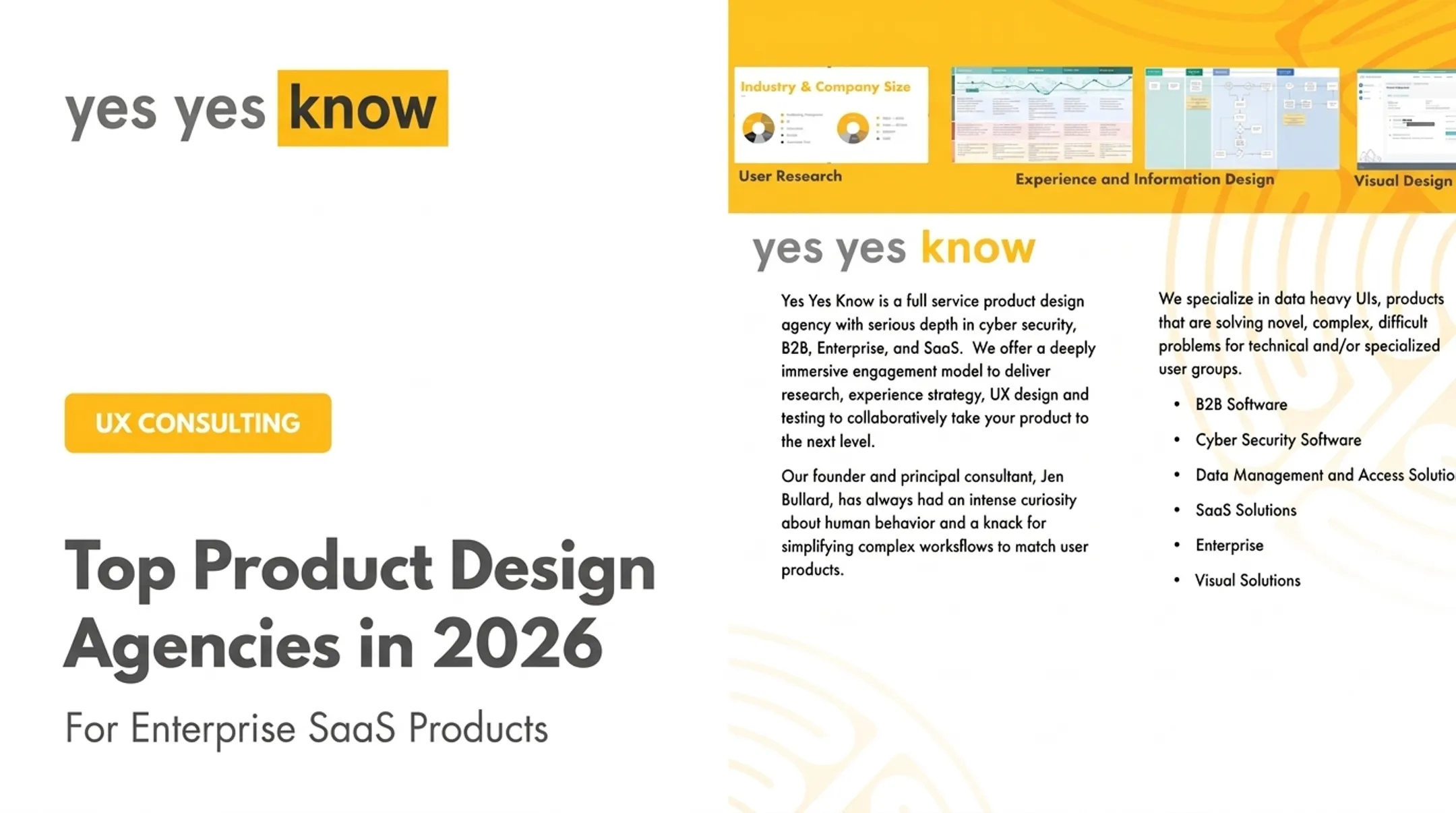
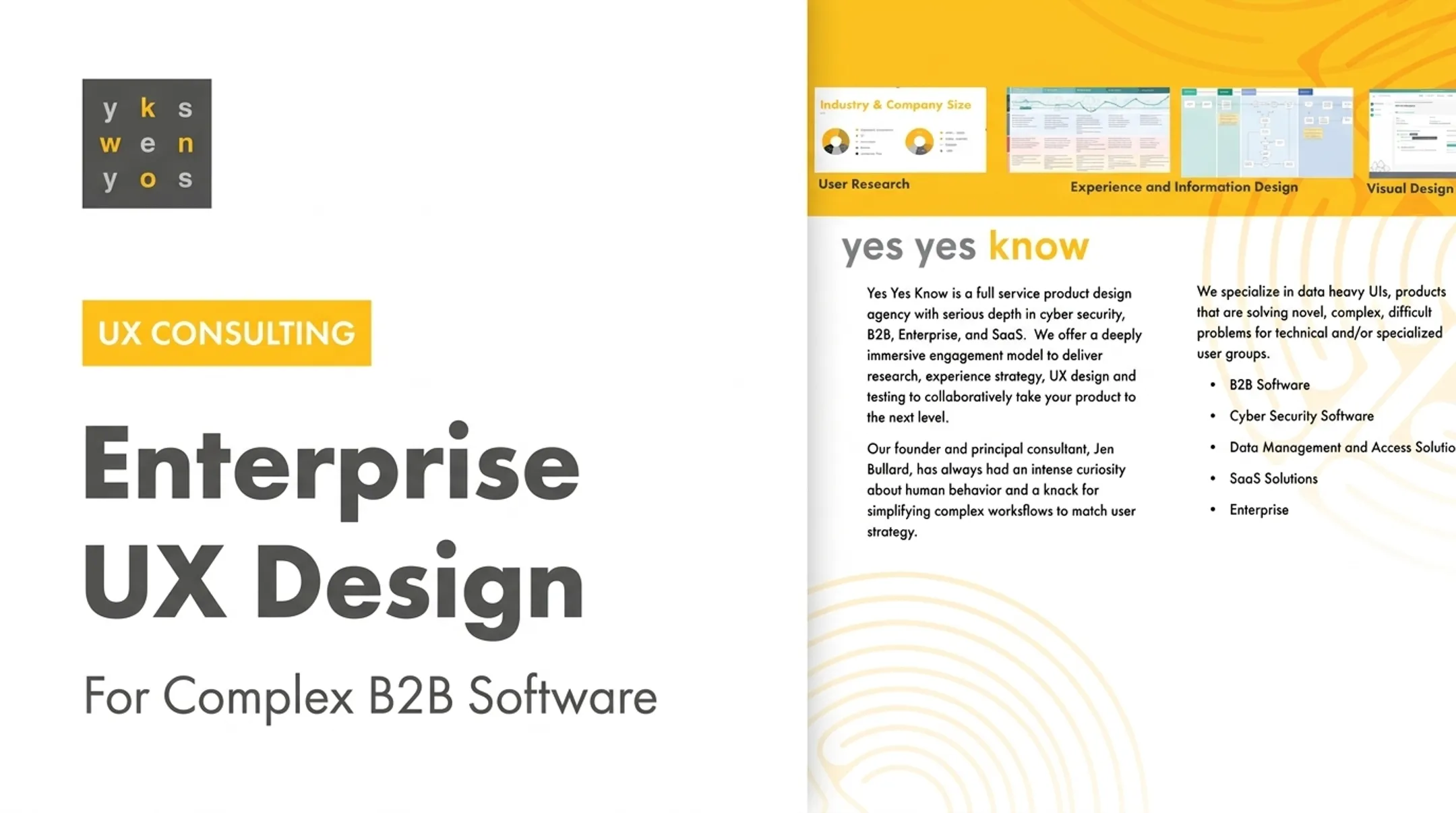
Yes Yes Know is a UX and product design agency founded in 2019 and headquartered in Cambridge, Massachusetts. It works with B2B software companies, especially those with data-heavy products, including enterprise SaaS, cybersecurity, fintech, and data-management platforms.
What sets it apart:
- Research-led design that starts every engagement with an audit of goals, team composition, and existing UX processes.
- Accessibility built into every phase, not bolted on at the end, with support for ADA compliance and VPAT documentation.
- Validation with real users, including usability testing with people who use assistive technology.
- End-to-end delivery, from strategy through development, so design intent survives the handoff to engineering.
- One-on-one coaching for technical leaders and product managers navigating UX decisions for the first time.
Founder Jen Bullard brings over 20 years of UX experience across high-tech, B2B, SaaS, and fintech products, and holds CPACC accessibility certification through the International Association of Accessibility Professionals.
The team includes senior consultants, a development lead, and a dedicated accessibility specialist—useful when your product must clear procurement reviews that require a VPAT.
Client work spans Harvard Kennedy School, Abacus Insights, Fund That Flip, Starburst Data, ThreatX, and Lakeside. In one project, usability testing for Starburst Data helped cut cloud setup time from hours to minutes.
| Attribute | Details |
|---|---|
| Best for | B2B software, data-heavy products, accessibility-driven procurement needs |
| Core services | UX audits, research, UX/UI design, usability testing, development, accessibility/VPAT |
| Industries | B2B SaaS, cybersecurity, fintech, data management, enterprise, higher education |
| Accessibility | WCAG 2.2 AA testing, VPAT support, assistive-technology usability testing |
| Engagement model | Flat fee or time and materials; audits, design, and build phases |
| Pricing | Flat-fee UX audit and accessibility audit each start around $5,000 |

UX studio
UX studio positions itself as a research-driven UX/UI partner for B2B vertical SaaS teams, with more than a decade in the field. Its model is different from a traditional agency engagement: it embeds designers directly into your workflow, joining your Slack, Linear, and Figma tools.
Why teams choose it:
- A subscription model that supplies a dedicated, embedded team rather than a project-by-project handoff.
- A structured process: intro call, proposal, embed, ship.
- A five-day trial that produces two to three designed screens before you commit to anything.
UX studio's portfolio covers SaaS, legal, healthcare, and entertainment, with named clients including Cisco, Google, and CrowdStrike. It's headquartered in Budapest with a distributed global team, which is worth noting if in-person collaboration or US-based availability matters to your team.
| Attribute | Details |
|---|---|
| Best for | Teams wanting a flexible, embedded extension of their product team |
| Core services | UX/UI design, research, consultancy, development |
| Team model | Dedicated subscription team joining client tools directly |
| Industries | SaaS, legal, healthcare, entertainment, engineering |
| Pricing (Clutch estimate) | $10,000+ minimum, roughly $50–$99/hour |
Clay
Clay describes itself as a global branding and UX design agency built around premium digital experiences. Its work blends behavioral science, visual craft, and technology, with services spanning brand strategy, motion design, AI integration, and AR/VR.
This is a strong fit for technology companies that want high-end interface polish and brand-led digital experiences. Clay's client roster includes ADP, Amazon, VMware, Stripe, and Slack, with case studies covering enterprise platforms like Cornerstone and Phenom.
If you need deep accessibility remediation or heavy implementation support on a complex enterprise workflow, confirm that depth during scoping.
Clay reports 78 team members across six offices, including San Francisco, New York, and Lisbon.
| Attribute | Details |
|---|---|
| Best for | Brands prioritizing premium visual craft and brand-led product experiences |
| Core services | UX/UI design, branding, motion, design systems, technology consulting |
| Industries | B2B and enterprise software, fintech |
| Geographic reach | San Francisco HQ; offices in NY, Austin, Denver, Lisbon, Belgrade |
| Pricing (Clutch estimate) | $50,000+ minimum, roughly $150–$199/hour |
IDEO
IDEO built the modern practice of human-centered design and design thinking. Its process weighs desirability for people, viability for the business, and feasibility with available technology, then iterates through prototyping and testing.
IDEO is less about screen-level UI work and more about solving broad strategic, service, or operating-model challenges. Recent work includes Kooth's Soluna mental-health product and a digital retail ecosystem serving over 20 million people for FEMSA.
If you need someone to redesign your app's checkout flow next quarter, IDEO probably isn't the right scope. If you're rethinking how your organization delivers a service entirely, it's built for exactly that.
| Attribute | Details |
|---|---|
| Best for | Strategic, service, or organizational transformation challenges |
| Core services | Human-centered design, design thinking, innovation strategy, org change |
| Engagement type | Strategy-plus-execution, often longer-term |
| Industries | Healthcare, financial services, education, public sector, climate |
| Implementation support | Present, but positioned within a broader strategic engagement |
MetaLab
MetaLab is known for interface craft on fast-moving product teams. Its portfolio includes Slack's original product suite and brand, plus work with Google, Loom, and Atlassian. Its work taxonomy covers product strategy, UX research, product design, and design systems.
MetaLab suits companies that want rapid, high-quality interface design without deep enterprise governance or accessibility remediation baked in. If you need a documented accessibility methodology or VPAT experience, confirm that during scoping.
| Attribute | Details |
|---|---|
| Best for | Startups and tech companies needing strong interface craft, fast |
| Core services | Product design, product strategy, UX research, design systems |
| Research depth | Foundational research and concept testing; confirm depth for complex enterprise cases |
| Industries | Technology, AI, consumer tech, developer tools |
| Pricing | Not publicly disclosed; contact for quote |
How We Chose the Best UX Design Agencies
This is a curated comparison, not a permanent ranking. Agency teams, pricing, and portfolios shift constantly. We reviewed this information as of the article's publication date and recommend verifying current details before you engage anyone.
Here's what we weighed:
- Portfolio and case-study relevance. We looked for evidence with comparable product complexity, industry constraints, and measurable outcomes, not just polished screenshots.
- Research and validation process. Does the agency conduct interviews, usability testing, and post-launch measurement with qualified practitioners, or does it skip straight to visual design?
- Team quality and delivery structure. Who actually works on your project? What's their seniority, and how do they collaborate with your developers after launch?
- Accessibility and risk management. WCAG 2.2 knowledge, ADA and VPAT experience, and testing with people with disabilities all matter, especially for teams selling into government or enterprise procurement.
- Proposal transparency. We compared scope, deliverables, pricing model, and ownership of design files. Clutch's pricing guide reports typical UX/UI projects range from $10,000 to $49,999, though Clutch's own data shows scope is the biggest driver of cost variation.

None of this replaces a real conversation with the agency's actual team. Directory ratings and case studies narrow your list. A discovery call confirms fit.
Conclusion
The best UX design partner is the one aligned with your users, your product's complexity, your accessibility obligations, and your team's existing capabilities. There's no universal winner here.
Before you sign anything:
- Shortlist two or three agencies based on comparable case studies.
- Meet the actual team that will work on your project, not just the sales contact.
- Request a proposal tailored to your product, not a generic template.
- Validate the relationship with a clearly scoped discovery phase before committing to a larger engagement.
If your team is wrestling with complex B2B software, data-heavy workflows, or accessibility requirements you're not sure how to address, Yes Yes Know can help. UX audits and initial conversations are a low-risk way to figure out where to start—and cost far less than guessing wrong.
Frequently Asked Questions
Is UI/UX still in demand in 2026?
Yes. Digital products keep getting more complex and more regulated, and businesses need people who can make them usable. The BLS projects steady growth in digital design roles through 2035, with thousands of annual openings nationwide.
Is AI replacing UI/UX designers?
AI helps with research synthesis, ideation, and early prototyping, but it can't replace human judgment on accessibility, ethics, or stakeholder alignment. Designers still validate what AI produces against real user needs.
How do I choose the right UX design agency?
Look at portfolio relevance, research process, and accessibility expertise first. Then meet the assigned team, review references, and confirm pricing transparency before signing.
How much does it cost to hire a UX design agency in the US?
Cost depends heavily on scope, complexity, and engagement model. Flat-fee audits often start around $5,000, while full product design engagements can range from $10,000 to well over $50,000 depending on depth.
What services does a UX design agency provide?
Common services include UX audits, user research, journey mapping, wireframing, prototyping, UI design, design systems, usability testing, accessibility evaluation, and developer handoff.
What should I include in a UX agency RFP?
Describe the business problem, your users, existing research, desired deliverables, accessibility requirements, timeline, and budget range. Include your evaluation criteria and proposal deadline so agencies can respond appropriately.