Introduction
A polished layout won't save a product that sends users down the wrong path. Teams still struggle when business goals, user needs, accessibility, and tech decisions never connect—and the result is slow adoption, support load, and features nobody uses.
That's where a web design strategist comes in. This person sets the direction behind a website or digital product so teams know what to build, for whom, and in what order.
For complex B2B software, SaaS, fintech, and cybersecurity products, the stakes are higher. Users moving through dense data and specialist workflows need more than a clean UI—they need a structure that matches how work actually gets done.
This article covers what a web design strategist does, how strategy runs from research through validation and launch, and what to look for when you hire one for a data-heavy product.
Key Takeaways
- Web design strategists connect user research to business objectives before visual design begins.
- Core deliverables span audits, information architecture, content strategy, accessibility planning, and measurement frameworks.
- Complex B2B software, SaaS, enterprise, fintech, and data-heavy products see the highest return from this role.
- Effective strategists communicate fluently across business, design, content, product, and development teams.
What Is a Web Design Strategist?
A web design strategist develops the direction, structure, and priorities for a website or digital product before and during design and implementation. Nielsen Norman Group describes the closest formal discipline, UX strategy, as a time-bounded plan built on vision, goals, measures, and an action plan that ties user-experience improvements directly to business objectives.
Strategist vs. Designer: Different Jobs, Same Goal
The strategist determines the problem to solve and the experience to create. The visual designer translates that direction into interfaces, layouts, and visual systems. Neither role replaces the other.
At Yes Yes Know, this distinction shapes the entire process. Designers work with research and strategy outputs to turn ideas into effective experiences, but only after users are defined and an architecture is in place.
How Strategy Differs From Marketing and Product Strategy
These disciplines overlap around audiences, goals, and conversion, but each has a distinct focus:
- Marketing strategy increases the perceived value of a product or service.
- Product strategy defines the broader vision, market opportunities, and initiatives.
- UX/design strategy reduces the effort required to complete a task, sitting inside or alongside the other two.
Why Strategy Matters More for Complex Products
Simple marketing sites can survive without deep strategy work. Dense B2B software cannot. Users juggling multiple roles, technical constraints, and specialist workflows need a structure that anticipates their needs.
Strategy work for these products typically produces:
- Research summaries and audience or user profiles
- Experience principles and information architecture
- Content direction and prioritized recommendations
- Accessibility requirements and success measures
What Does a Web Design Strategist Do?
A strategist's day-to-day work spans four connected activities: clarifying business objectives, choosing research methods, mapping journeys, and shaping structure.
Clarifying Business Objectives
The strategist interviews stakeholders, identifies constraints, and reviews existing goals. This turns broad ambitions, like "increase adoption," into specific, actionable priorities for the site or product.
Choosing the Right Research Methods
Not every project needs every research method. As NN/g notes, qualitative methods answer why and how, while quantitative methods answer how many and how much. A skilled strategist recommends the right mix rather than running every method by default.

Common approaches include:
- Stakeholder interviews to surface internal constraints and success metrics
- User interviews to understand attitudes and work practices
- Usability testing to catch where terminology or navigation breaks down
- Analytics review to spot behavior patterns in existing systems
- Competitive evaluation to benchmark experiences, not just features
Mapping Journeys and Fixing Friction
Strategists map user journeys and key tasks to find friction points, unclear messaging, unnecessary steps, and missing information. This is where the highest-value improvements usually surface first, often before any visual design work begins.
Shaping Structure and Content
Information architecture and content strategy cover navigation, page hierarchy, labeling, search, and calls to action. The goal is simple: deliver information in the order users actually need it, not the order the organization stores it.
Throughout all four activities, the strategist works with designers, developers, product managers, and subject-matter experts to prioritize recommendations and keep the experience aligned with real needs.
At Yes Yes Know, this often means applying a Jobs To Be Done lens, where product management identifies which jobs need doing and UX decides which jobs to prioritize first.
How Web Design Strategy Works From Research to Launch
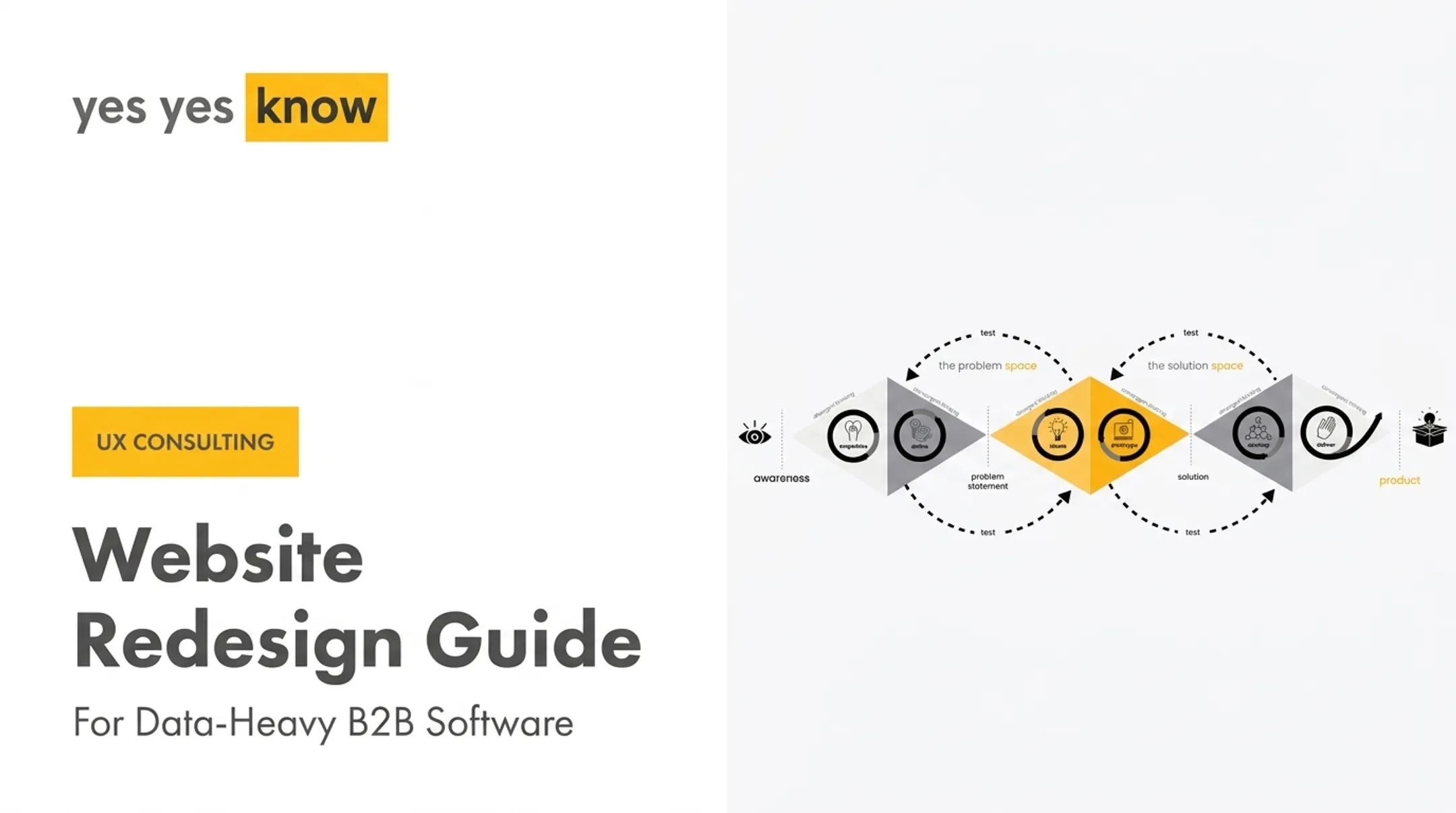
Strategy isn't a single meeting. It's a five-stage process that carries through implementation and beyond.
Discovery and audit. Establish business context, target users, existing performance, technical environment, and accessibility needs. This stage defines the specific problem the project must solve.
Research and synthesis. Gather evidence from users, customers, internal teams, analytics, and competitor experiences. Group findings into needs, pain points, opportunities, and risks.
Strategic direction. Define audiences, user journeys, experience principles, content priorities, and information architecture. Package it all into a prioritized roadmap tied to business goals.
Design collaboration and validation. Guide wireframes, prototypes, and content decisions. Test important workflows with representative users, then revise based on evidence, not assumptions.
Implementation and continuous improvement. Collaborate with development, support quality assurance, and establish measurement criteria. Launch is a milestone; measurement and iteration continue after go-live.

A Data-Heavy Workflow Example
Consider a B2B analytics platform where users struggle to build advanced search queries. A strategist would first audit existing workflows and interview users about where they get stuck.
Research often turns up confusing nomenclature, cumbersome data grids, or hidden actions—the kinds of issues common in dense enterprise tools.
Yes Yes Know faced a similar challenge with data platform client Starburst Data. Combining usability testing with product strategy, the team cut a setup process from hours to minutes. That result was specific to the engagement, not a universal benchmark.
Skills and Qualities to Look for in a Web Design Strategist
Not every UX-adjacent professional can do this work well. Here's what separates a strong strategist from someone who's just good at wireframes. Research and analytical thinking. The strategist should turn qualitative feedback, quantitative data, and business requirements into clear priorities, without leaning on personal preference to fill the gaps. Systems thinking. Pages, workflows, content, navigation, roles, and technical systems all connect. A strategist needs to see the whole map, not just individual screens. Communication and facilitation. This role lives and dies on the ability to:
- Explain recommendations clearly to non-design stakeholders
- Manage competing opinions without losing momentum
- Run workshops that produce actual decisions
- Document choices so teams stay aligned later Accessibility and inclusive design. Familiarity with WCAG expectations, keyboard and assistive-technology considerations, and inclusive research practices isn't optional for serious B2B work. That holds especially for companies selling into government, education, or enterprise procurement. Business and technical fluency. A strategist should understand goals like adoption, qualified leads, or compliance, while also recognizing development constraints, platform limitations, and maintainability. Yes Yes Know's approach reflects this mix directly. Engagements move through audits and strategy, then design, validation, development, and accessibility work, covering the full arc rather than handing off strategy and walking away. Founder Jen Bullard holds CPACC certification through the International Association of Accessibility Professionals. The team's UX audits pair automated and manual accessibility testing with real usability evaluation, matching the blended skill set this role demands.

Frequently Asked Questions
What does a design strategist do?
A design strategist connects user needs, business goals, research, and content into a clear direction for what should be built and why. They set priorities before design or development starts, not after.
Do you need a degree to be a strategist?
A specific degree isn't required, but research, UX, communication, and analytical skills matter most. Relevant education, a strong portfolio, and hands-on experience all strengthen credibility.
Is web design still in demand in 2026?
Demand remains strong. The U.S. Bureau of Labor Statistics projects 5% growth for web developers and digital designers from 2025 to 2035, with about 13,600 openings a year—faster than average.
What is the difference between a web designer and a web strategist?
The strategist focuses on research, priorities, and structure, deciding what needs to exist and why. The designer translates that direction into visual and interactive experiences. Some professionals do both.
When should a business hire a web design strategist?
Common triggers include a confusing website, redesign uncertainty, fragmented user journeys, conflicting stakeholder priorities, or a new digital product that needs direction before design and development begin.